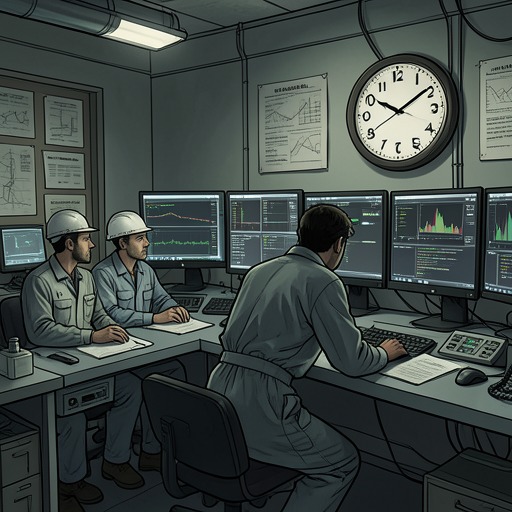
Fragment Assessment Team
The Wisdom of CrowdsThe Debris Assessment Team (DAT) was a group of engineers from NASA, Boeing, and Lockheed Martin convened to assess the possible damage caused when foam broke from the Columbia’s external fuel tank and struck the shuttle’s left wing. Its analysis exposed the limits of the evidence available, but the team’s concerns did not reach decision-makers with their full force. The DAT’s place in the Columbia crisis shows why specialized, decentralized expertise matters—and why it cannot protect a group when channels for sharing and weighing that expertise fail.
Formation and Technical Task
During the ascent of the Columbia on January 16, 2003, a large piece of foam broke off the external fuel tank’s left bipod area and hit the shuttle’s left wing. Launch cameras did not capture a clear image of the impact, leaving engineers uncertain about the size of the foam and the damage it might have caused. The DAT, made up of engineers from three organizations, spent much of the following five days evaluating the strike. Its members estimated the foam’s size and impact speed, then used Crater, an algorithm designed to predict how deeply debris would penetrate the shuttle’s thermal-protection tiles.
The lack of on-orbit images constrained the investigation from the outset. Although a request for pictures of the Columbia had been made by January 21, the images had not been approved. Without knowing exactly where the foam had hit, the engineers could not assess the damage with confidence. Their analytical tool imposed another limitation: Crater had been designed for debris hundreds of times smaller than the piece that struck the shuttle. The DAT therefore had neither a reliable view of the impact site nor a tool validated for the scale of the impact.
Warnings and Uncertainty
By January 21, the DAT had reached no conclusion, but it had made clear to Don McCormack that there was reason for concern. McCormack had been briefed by the engineers an hour before a Mission Management Team teleconference, yet he did not convey their concern to the meeting. When the foam strike finally came up, he said that investigators were assessing possible damage and repair options. He also noted that a similar strike on an earlier shuttle mission had caused fairly significant damage. The DAT’s caution, however, did not become the meeting’s focus.
As its study continued, the DAT became increasingly concerned that the foam might have damaged tiles enough to cause burn-through when the shuttle reentered the atmosphere. On January 24, its engineers presented five possible scenarios. Their conclusion leaned toward the shuttle being safe, but they emphasized that the analysis was profoundly limited by the lack of good information and by the tools available. The team could not establish the strike’s precise location, and Crater’s scale mismatch made its results uncertain. The engineers’ qualifications were central to what they reported; they were not a minor caveat to a settled finding.
Information Lost in the Chain of Command
The DAT’s evidence and reservations reached the Mission Management Team through McCormack, who had become the engineers’ unofficial liaison. In the January 24 meeting, he summarized the study by saying that the thermal analysis did not indicate potential for burn-through, while also acknowledging uncertainty about the debris size, impact location, and angle. Linda Ham, the Mission Management Team leader, responded with questions that recast this tentative account as reassurance: no burn-through, she suggested, meant no catastrophic damage and no safety-of-flight issue. The conversation moved on without a member of the management team asking to see the DAT study or probing its uncertainties.
Earlier, when the DAT sought on-orbit images, the request was canceled on the reasoning that nothing could be done even if damage were found. That assumption narrowed the investigation before its evidence was complete. The DAT’s concerns, including the need for images to support an informed analysis, did not receive a serious hearing. The book’s account places this failure within NASA’s hierarchy: a technically specialized team could identify uncertainty, but its position in the organization did not give its warning enough weight to shape the decision.
Organizational Significance
The DAT illustrates the strength and vulnerability of decentralized expertise. Engineers close to the technical problem could apply specialized knowledge to the foam strike, just as local knowledge can help individuals solve problems that a distant authority cannot understand as well. But decentralization alone does not make an organization intelligent. Information uncovered in one part of a system has to travel through the system and be combined with other judgments. Without that aggregation, valuable local knowledge may remain isolated or arrive stripped of the qualifications that give it meaning.
The account contrasts the DAT’s analytical role with the broader problem of information flow in large organizations. A hierarchy can obstruct communication between people doing specialized work and those empowered to act on it; a separate intelligence example in the book makes the complementary point that decentralization without a means of aggregating judgments leaves an organization without an effective collective decision. In the Columbia case, the DAT could investigate the strike, but the management process did not draw its uncertainty into a sustained, open examination. The team’s significance lies not in having produced a definitive answer—it had not—but in showing that technically responsible caution is useful only when an organization is willing to receive, preserve, and act on it.